


ISTANBUL, TURKEY
September 22, 2026
BBS Grain 2026
Balkans & Black Sea Grain 2026
BECOME A PART OF #BBSGrain



350+
ATTENDEES
35+
COUNTRIES
ATTENDEES
35+
COUNTRIES
The second international conference
"Balkans & Black Sea Grain",
which took place last year in Istanbul, was attended by more than 350 delegates from 35 countries.
This event aroused wide interest among the professional community.
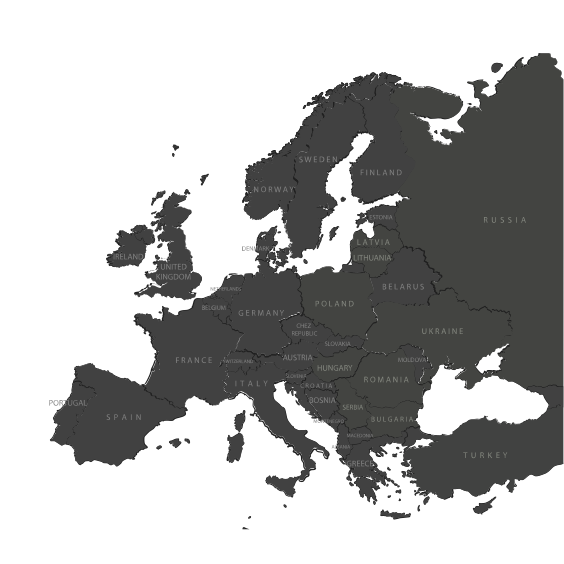
The Black Sea region is the most important for wheat and vegetable oils importers from the MENA countries.
Russia and Ukraine are the leading agricultural products suppliers to Egypt, Algeria, Iran and other countries in the region, as well as Turkey.
In addition to these leaders, Romania, Bulgaria and Serbia are actively developing grain exports. Thus, Romania is one of the largest grain sellers in the European Union and, along with France and Russia, actively supplies wheat to the Middle East, and Egypt is the main buyer of Romanian wheat.
Serbia has at least 1.5 million tons of grain export potential annually, which are shipped through the Romanian port of Constanta.
In addition, by the end of the current season, Serbia is likely to export 2.6 million tons of corn and regain its position as one of the leading European corn exporters.
Serbia has at least 1.5 million tons of grain export potential annually, which are shipped through the Romanian port of Constanta.
In addition, by the end of the current season, Serbia is likely to export 2.6 million tons of corn and regain its position as one of the leading European corn exporters.
In turn, Bulgaria is the 12th largest wheat exporter in the world. Main wheat exports from Bulgaria are: Algeria, Egypt, Tunisia, Greece and Pakistan.
Thanks to large initial stocks and good export demand, Bulgarian wheat exports increased to more than 3.3 million tons in 2023-2024, which will mark Bulgaria's return to the global grain market after a disastrous last season.
Neighboring Hungary started shipping wheat to Tunisia and Egypt last year, taking advantage of the possibilities of Croatia's ports.
Thanks to large initial stocks and good export demand, Bulgarian wheat exports increased to more than 3.3 million tons in 2023-2024, which will mark Bulgaria's return to the global grain market after a disastrous last season.
Neighboring Hungary started shipping wheat to Tunisia and Egypt last year, taking advantage of the possibilities of Croatia's ports.
All these examples indicate that a new export region is being formed on the market - the Black Sea region, the Danube and the Balkans.
Russia, world’s largest wheat exporter, and Ukraine, a key grain supplier, face unique challenges. Firstly, demand from traditional importers such as Turkey is declining. China, one of the world’s largest food buyers, has approved a grain development plan for 2026–36 that will significantly increase domestic grain production.
The Black Sea region remains one of the key sources of wheat and vegetable oil supplies to the markets of the Middle East and North Africa (including Egypt, Algeria, and Iran), as well as Turkey.
At the same time, demand in the largest markets of MENA and Turkey increasingly depends not only on prices, but also on procurement mechanisms and regulations.
In 2025, for example, Turkey eased restrictions and opened duty-free wheat imports for millers under a processing regime with subsequent export of flour. Against this backdrop, competition is intensifying—both within the Black Sea region and the Balkans, and from other exporters investing in the region's trade and logistics infrastructure.
At the same time, demand in the largest markets of MENA and Turkey increasingly depends not only on prices, but also on procurement mechanisms and regulations.
In 2025, for example, Turkey eased restrictions and opened duty-free wheat imports for millers under a processing regime with subsequent export of flour. Against this backdrop, competition is intensifying—both within the Black Sea region and the Balkans, and from other exporters investing in the region's trade and logistics infrastructure.

We will talk about these and other trends at The Balkans & Black Sea Grain 2026


Also among the topics of the conference
Role of railway and river transport in grain exports
Crop forecast in exporting countries
Conflict in Ukraine impact on the export flows of Black Sea grain
Competition for the MENA countries markets, who will be the winner?
Investments in port infrastructure of the countries of the region: where are the weak points?



Join "Balkans & Black Sea Grain 2026" which will let you to take a fresh look at the latest trends in agricultural products trade and grain logistics.
With the help of our experts, you will be able to see the growing influence of the Balkans and the Black Sea region on the world cereals and oilseeds trade.
"Balkans & Black Sea Grain 2026" is a unique conference for industry professionals to network, exchange opinions and establish new business contacts.
Participants will have the opportunity to meet leading companies, experts, analysts and traders, as well as gain valuable information on the geopolitical and economic factors shaping global grain and oilseed trade.
Participants will have the opportunity to meet leading companies, experts, analysts and traders, as well as gain valuable information on the geopolitical and economic factors shaping global grain and oilseed trade.
Conference will gather together



Cereals and oilseeds producers


Flour milling companies
Commodity brokers
Logistics companies
Financial organizations
Authorities, industry associations

Participants geography
Romania, Bulgaria, Serbia, Ukraine, Hungary, Russia, Kazakhstan, Turkey, Poland, Lithuania, Latvia and other countries, mainly from EU and MENA

TICKETS
BBS Grain 2026
Places are limited
Conference participation fee September 22, 2026 conference and Grain Gala Dinner
590 Euro
If registration and payment before 31.03.2026
690 Euro
If registration and payment before 31.07.2026
790 Euro
If registration and payment after 31.08.2026
640 Euro
If registration and payment before 31.05.2026
890 Euro
If registration and payment after 01.09.2026
1000 Euro
Payment on the venue (subject to availability)
Discounts: participation of 3 or more company's representatives - 10%

For all participants registration fee includes:
- participation in all Conference events under the program;
- meals according to the program (lunches, coffee breaks);
- Grain Gala Dinner evening reception on September 22;
- QR code access to a closed section of the website* with the event program, list of participants, participating companies directory with contacts for communication, the ability to view and download presentations and many other functions (*or an alternative option for communication and receiving materials);
- handout in electronic and printed form;
- brief information about the company, contact information and logo placement in the electronic catalog of the Conference;
- materials on the results of the forum (photo report, presentations, participants catalog) in electronic form


Choose a type of cooperation, submit the form, and we will contact you soon.
Organizing Committee
info@bbsgrain.com
info@bbsgrain.com
LET’S COLLABORATE!

